
Navigating Complex Business Case Studies: A Guide to Academic Success
The modern UK business curriculum has shifted significantly toward experiential learning. For students at institutions like LSE, Warwick, or Manchester, the Business Case Study is no longer just an exercise—it is a simulation of high-stakes corporate decision-making. However, as these cases become increasingly data-heavy and multifaceted, many students find themselves submerged in “analysis paralysis.”
Success in these modules requires more than just reading the text; it demands a fusion of financial literacy, strategic foresight, and critical evaluation. When the pressure of overlapping deadlines for modules like Macroeconomics and Strategic Management mounts, it is common for students to seek professional guidance. Many choose to find experts who can write my assignment to ensure that the technical nuances of a SWOT or PESTLE analysis are captured with professional precision, allowing them to focus on the practical application of these theories.
The Rising Complexity of Business Education
According to the Higher Education Statistics Agency (HESA), Business and Management remain the most popular subjects in the UK, accounting for 17% of all students in the 2022/23 academic year. With such high competition, the complexity of assessments has risen to differentiate top-tier candidates.
A study by the Financial Times highlights that 85% of top-ranked MBAs now utilise live, “real-time” case studies rather than static historical texts. This means students aren’t just looking at what happened to Nokia in 2010; they are predicting what will happen to NVIDIA in 2026.
1. The Anatomy of a High-Scoring Case Study Analysis
To move from a 2:1 to a First-Class mark, your analysis must follow a logical, data-driven structure:
- The Executive Summary: This is your “elevator pitch.” It should outline the core problem and your primary recommendation in under 250 words.
- The Situational Audit: Use frameworks like Porter’s Five Forces or the VRIO framework to evaluate the firm’s competitive position.
- Financial Health Assessment: You cannot pass a business case without looking at the balance sheet. Calculate the Current Ratio, ROE (Return on Equity), and Net Profit Margins.
- Strategic Alternatives: Never provide just one solution. Offer three, and explain why your chosen one is superior.
The financial burden and time investment of these degrees are substantial. Given that the average UK student debt is now estimated at over £45,000, the stakes for academic performance have never been higher. To protect this investment, some students decide to pay for assignments when they encounter particularly dense financial modelling or econometric data that requires a specialist’s touch to interpret correctly.
See also: Peptide Research Chemicals: The Ultimate Guide to Benefits, Uses, and Safety in 2026
Data-Driven Insights: Why Students Struggle
Research from the National Union of Students (NUS) indicates that 62% of UK students feel that their academic workload has a negative impact on their mental wellbeing. The specific “pain points” in business studies include:
| Challenge | Impact on Grade | Root Cause |
| Data Misinterpretation | High | Lack of statistical software (SPSS/Stata) skills. |
| Vague Recommendations | Medium | Failure to link theory to the specific case context. |
| Poor Formatting | Low/Medium | Incorrect referencing (Harvard or APA style). |
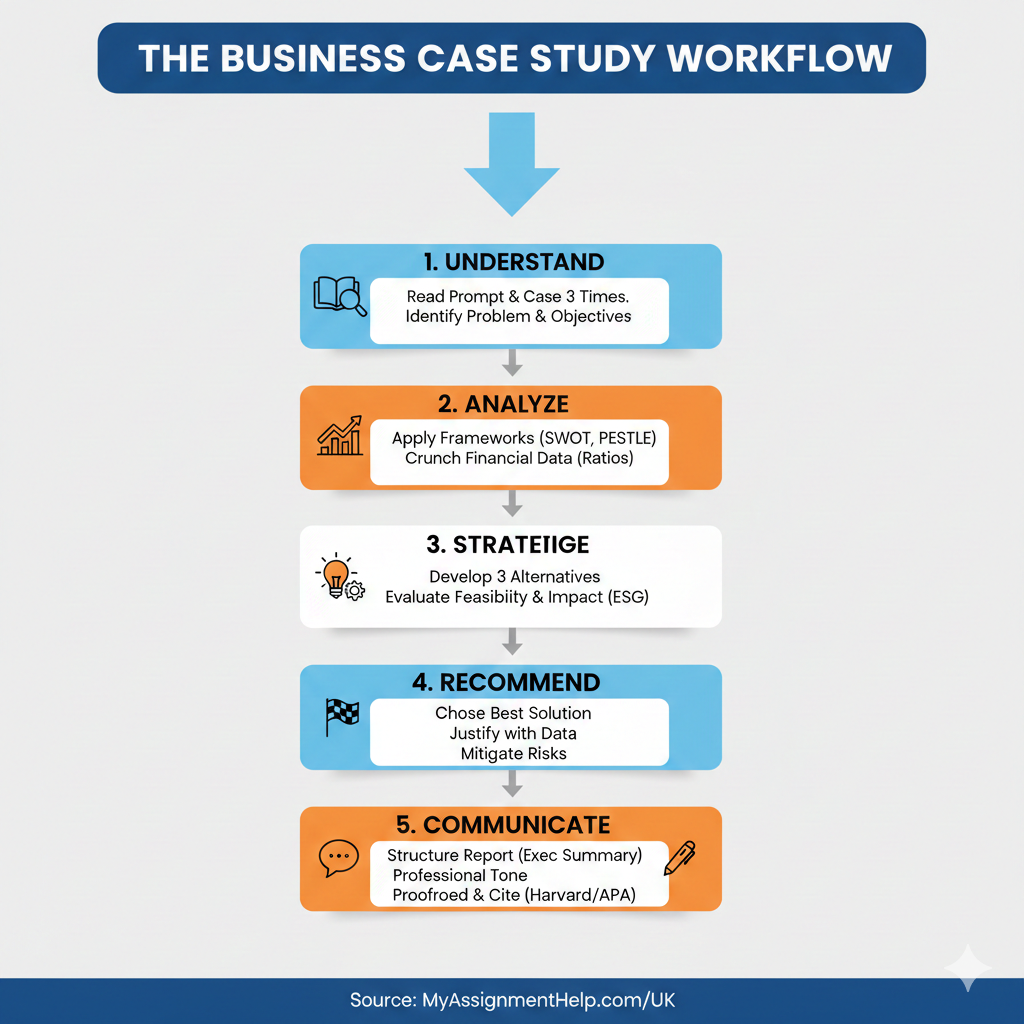
5 Steps to Mastering Your Business Case Study
Step 1: Read Three Times
- First Read: Skim for the general narrative.
- Second Read: Highlight key financial figures and dates.
- Third Read: Identify the “hidden” problems (e.g., a company might have high sales but a toxic culture leading to high turnover).
Step 2: Apply the “So What?” Filter
For every piece of data you include, ask “So what?” If you note that “The company has a high debt-to-equity ratio,” follow it up with: “This limits their ability to secure further funding for R&D in the 2026 fiscal year.”
Step 3: Quantify Everything
Don’t say “The company is doing well.” Say “The company saw a 12% Year-on-Year (YoY) increase in EBITDA, outperforming the industry average of 8%.”
Step 4: The Triple Bottom Line
Modern UK business markers look for Sustainability (ESG). Does your solution help the planet and people, or just the profit margin?
Step 5: Professional Proofing
Ensure your tone is objective. Avoid “I think” or “I feel.” Use “The data suggests” or “Evidence indicates.”
The Case Study Workflow
Conclusion: Balancing Theory and Practice
Navigating complex business cases is the ultimate preparation for a career in consultancy, management, or entrepreneurship. By treating every assignment as a real-world boardroom presentation, you develop the critical thinking skills that top recruiters value. Whether you are leveraging peer-reviewed journals or seeking expert academic assistance to bridge a knowledge gap, the goal remains the same: excellence.
FAQs
Q: What is the most common mistake in business case studies?
A: Focusing too much on the history of the company rather than solving the future problems presented in the case.
Q: Which framework is best for international business cases?
A: PESTLE (Political, Economic, Social, Technological, Legal, Environmental) is the gold standard for analyzing international market entry.
Q: How do I find reliable financial data for UK companies?
A: Use Companies House for official filings or databases like Bloomberg and Statista for market trends.
References
HESA (2024): Higher Education Student Statistics: UK, 2022/23. Available at: hesa.ac.uk
Financial Times (2025): The Evolution of the MBA: From Theory to Real-Time Analysis.
NUS UK (2023): Student Mental Health Research Report.
Office for Students (OfS): Quality and Standards in UK Business Education.
Author Bio
James Sterling is a Senior Content Strategist and Academic Consultant at MyAssignmentHelp with over 12 years of experience in the UK higher education sector. A former visiting lecturer in Business Management, James specialises in helping students bridge the gap between academic theory and corporate reality. He is a regular contributor to debates on educational technology and student productivity.